
Badminton may look simple because the objective is to hit the shuttle over the net and prevent it from landing on your side. However, playing correctly requires more than keeping a rally going. You need an appropriate grip, balanced movement, an early contact point, controlled strokes, and a reliable recovery position.
At Dynamic Badminton Academy, we teach beginners to connect these fundamentals rather than learn isolated shots. A strong smash is not useful when poor footwork leaves you off balance. Correct badminton is about using efficient technique to produce consistent, repeatable play.
Start by learning what you are trying to achieve during each rally. Send the shuttle into the opponent’s court while preventing a successful return. You should recognise the singles and doubles boundaries, service courts, basic scoring, and the situations that end a rally.
You do not need to memorise every regulation before your first lesson, but basic rules prevent confusion during practice. The Badminton World Federation publishes the official Laws of Badminton within its statutes for players who need the complete regulations.
Many beginners squeeze the handle because they believe a tight grip creates power. Excessive tension restricts finger and wrist movement, slows grip changes, and tires the arm.
Begin with a relaxed forehand grip that feels similar to gently shaking hands with the racket. Control the handle with your fingers and tighten briefly only when striking.
You should also learn a suitable backhand grip instead of turning the whole arm awkwardly. Smooth grip changes help you react quickly without forcing the wrist into uncomfortable positions.


A correct ready position prepares you to move in any direction. Keep your feet slightly wider than shoulder width, bend your knees gently, and place your weight toward the front of your feet.
Hold the racket in front of your body instead of letting it hang beside your leg. Avoid standing upright with locked knees or leaning heavily in one direction.
Your stance can change according to the rally, but the core principle remains the same. Stay balanced, alert, and ready to make a quick first movement.
Correct badminton begins with positioning. Reaching with the arm alone usually creates a weak or inaccurate return when the shuttle is far from your body. Move your feet first so your body arrives in a stable hitting position.
Use short adjustment steps rather than one uncontrolled stride. Beginners should learn to move from a central base, reach the shuttle, and recover efficiently through patterns such as split steps, chasse steps, cross steps, and lunges.
Our guide on how to improve badminton footwork explains these movements in greater detail.
Your contact point strongly affects control. For most overhead forehand shots, meet the shuttle high and slightly in front of your racket shoulder.
Waiting until it travels behind you reduces your options and often forces a weak return. At the net, early contact lets you play tighter and more threatening shots.
Watch the shuttle from your opponent’s racket until you strike it, rather than looking toward the target too soon. Correct timing means reaching the right position early enough to choose and execute an appropriate shot.
Beginners often measure improvement by how hard they can smash. We prefer to establish clean contact, direction, length, and consistency first.
Clears, drops, drives, lifts, net shots, serves, and smashes each solve a different tactical problem. Playing correctly means choosing the right stroke instead of attacking every shuttle.
Use a smooth swing and avoid forcing the shot entirely with your shoulder. Power develops through coordinated fingers, forearm rotation, body position, and timing. Increase speed only after you can repeat the stroke without losing control.
A rally does not end when you hit the shuttle. After each stroke, regain balance, return the racket to a ready position, and move toward an appropriate recovery base.
Watching your shot while remaining in the corner leaves open space for your opponent. In singles, recovery often means returning toward a balanced central position.
In doubles, it depends on whether your pair is attacking, defending, or rotating. Learning this habit early makes your movement continuous instead of a series of late and hurried reactions.
Playing more games builds experience, but games alone may reinforce poor technique. Structured practice isolates a skill long enough for you to understand and repeat it.
Shadow footwork, target hitting, controlled rallies, service practice, and multi-shuttle feeding can support different areas of development. Sport Singapore encourages accessible learn-to-play opportunities and structured sports participation across Singapore.
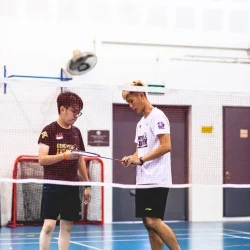
The same principle applies to academy training. Through our beginner-friendly private badminton lessons, we identify technical errors early and develop drills around your movement, timing, ability, and playing goals.
To play badminton correctly, learn the court, relax your grip, use a balanced stance, move before swinging, contact the shuttle early, control your strokes, recover after every shot, and practise with clear objectives.
These habits make the game safer, more consistent, and more enjoyable. They also prepare you for advanced skills by giving your movement and stroke production a dependable base.
At Dynamic Badminton Academy, we provide customised badminton lessons across Singapore for beginners, children, adults, and improving players. Contact us to arrange a suitable programme and begin learning with structured coaching.
Beginners should first learn the ready position, relaxed grip, basic footwork, and clean shuttle contact. These skills support every stroke and prevent learners from developing inefficient habits that become difficult to correct later.
Progress depends on training frequency, coordination, fitness, and the quality of feedback. Many beginners can develop basic rally control within several lessons, while dependable movement and stroke consistency require regular practice over a longer period.
You can learn basic ideas through videos and casual practice, but self-learning makes technical errors harder to detect. A coach can correct your grip, movement, timing, and contact point before weak habits become established.
Beginners often miss because they are late to the shuttle, stand too upright, swing before positioning, or look away from the shuttle. Improving footwork, preparation, and contact timing usually produces more consistent results.
Click on the link to find out more about Dynamic Badminton Academy. Chat with our Coach today!
Home
About Us
Private Badminton Lessons
Kids Badminton Lessons
Group Badminton Lessons
WhatsApp Us