
How To Tell A Good Badminton Coach From A Cheap One


Anyone can call themselves a coach. In Singapore there is an actual qualification behind the word, and most people looking for a good badminton coach have never been told what it is.
This covers the part you can verify before you pay, and the part you can only judge once you are on court.
Accreditation in Singapore runs through the Singapore Coach Excellence programme, which requires a skills test, a Level 1 coaching course, first aid certification and registration on the national coaches’ register. That is the floor. A good badminton coach is then judged on whether they watch you more than they talk, correct one thing at a time, and can say what they are working on and why.

Singapore has a national standard, and it is more specific than most people expect.
The Singapore Badminton Association sets out the route: a candidate must first pass a skills test run by the association, then complete the Singapore Coach Excellence Full Integration Programme Level 1 for badminton, which includes the BWF Level 1 technical component and foundational sport science. A valid first aid certification is required, and coaches apply for membership of the National Registry of Coaches.
So “certified” is not a vague claim. It is a specific programme with a specific name, and it is reasonable to ask which level a coach holds and whether they are on the register.
Here is the part nobody selling you coaching will say: the qualification tells you someone is safe and technically sound. It does not tell you they are good at teaching your child, or you.
Coaching is two jobs. Knowing what is wrong is the first, and it is the one the certification covers. Getting a particular person to change it is the second, and nothing on a certificate predicts it.
That is why a good badminton coach is judged on a session rather than on a credential, and why the rest of this page is about what to watch.


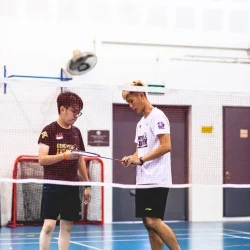
A good badminton coach gives away how they work almost immediately. Watch the ratio of watching to talking.
A coach who spends the first twenty minutes feeding shuttles and saying very little is usually doing the right thing. They are collecting information. A coach who starts correcting in the first five minutes is working from a script rather than from you.
The second signal is how many things they change. One correction, held for the rest of the hour, beats six corrections that all get forgotten by Thursday. If you leave a first session with a list, the list is the problem.
Take a trial before committing to a term. Our badminton trial class exists for exactly this, and any coach who discourages one is telling you something.
Do they explain why, or only what? “Get your racket up earlier” is an instruction. “Get your racket up earlier because you are arriving late and that is why the shuttle is behind you” is coaching.
Do they watch your feet? Most faults people think are stroke faults are position faults. A coach looking only at your arm is looking at the wrong end.
Do they adapt the session? A session that runs identically regardless of what you show them in the first ten minutes was planned before you arrived.
Can you repeat back what you worked on? If you cannot name it in the car park, it will not survive the week.
Do they say what they are not fixing yet? A good badminton coach is happy to say “your backhand is poor and we are ignoring it until your base position is fixed.”

Four questions, and the answers tell you more than any website will.
What qualification do you hold, and are you on the national register? A straightforward question with a straightforward answer.
Who do you usually teach? A coach whose students are mostly competitive juniors is not necessarily right for an adult returning after fifteen years.
What would you do in the first session with someone at my level? A specific answer is a good sign. A general one is not.
How will I know it is working? Anyone who says “you’ll feel it” is guessing. Technique changes show up in specific, nameable ways.
None of these make somebody a bad coach. They make them the wrong coach for a particular player, which is a different and more common problem.
Sessions that are mostly the coach playing against you. That is a hitting partner, and it has its place; our badminton hitting partner page covers when it is what you want. It is not coaching.
Drills with no stated purpose. Repetition without a target is exercise.
A coaching style that does not match how you learn. Some players need to be pushed and some need to be encouraged, and a mismatch stalls progress even when the technical content is right.
A coach who is excellent with competitive juniors can be poor with a forty-year-old beginner, and the reverse is just as true.
Children build through shorter, more varied blocks and learn by copying. Adults can hold a single correction for much longer and generally want to understand the mechanism before they trust it. Our kids badminton lessons and adult badminton lessons pages are separate for that reason rather than for scheduling.
Parents have one extra test available to them. Watch whether your child talks on the way home. Engagement is visible long before technique is.
Three routes, with honest trade-offs.
Community centres and ActiveSG group programmes are the cheapest way in and the easiest to start. Class sizes are larger, so individual correction is limited.
Private academies run one-to-one and small-group sessions with structured progression. It costs more per hour and it is the fastest route for a beginner forming first habits, which is what our private badminton lessons page describes.
Word of mouth through a club or a regular game finds you coaches who never advertise. Ask the strongest player at your session who taught them.
Whichever route, sort out the hall before you sort out the coach. Our guide to where to learn badminton in Singapore covers how booking works, and availability decides more schedules than anything else does.
Technique changes inside four to six weekly sessions. That is the honest range for most adults working with a good badminton coach on one thing at a time.
Match results take longer, because they depend on how much you play between sessions. A student who plays socially twice a week improves faster than one who only sees a coach, every time.
What should change immediately is understanding. After one good session you should be able to name what you are working on and say why it matters. If you cannot, that is worth raising rather than waiting out the term.
We coach adults, children and pairs across the island, and we will tell you at the enquiry if we are not the right fit.
If you describe who is playing, their rough level, where you are and when you can reliably make, we will say which format suits and why. Our badminton lessons page lists every format we run and sets out how a correction is actually made to hold under pressure.
An honest no at the enquiry costs you nothing. A term with the wrong coach costs considerably more.

A: Ask which Singapore Coach Excellence level they hold and whether they are on the National Registry of Coaches. The Singapore Badminton Association runs the skills test and the Level 1 programme, so the answer should be specific rather than vague.
A: Being able to see a fault and get a particular person to change it. Strong players often cannot explain what they do because it was never conscious, which is a different skill from playing well.
A: Yes, and any coach who discourages one is worth avoiding. A trial is the only way to judge teaching style, and style matters as much as technical knowledge.
A: Technique usually shifts within four to six weekly sessions. Match results take longer because they depend on how much you play between lessons, not on the lessons alone.