
Beginners may know how to clear, drop, drive, lift, or smash, yet still choose the wrong shot at the wrong moment. The result is often a weak return, poor recovery, or an unnecessary error.
At Dynamic Badminton Academy, we teach shot selection as a decision-making skill. The right shot is not always the most powerful option. It is the stroke that best suits the shuttle’s height, your balance, your court position, your opponent’s location, and the time available.
The shuttle’s height is one of the clearest guides. When you contact it high and in front, you normally have more attacking choices, including a clear, drop, or smash.
When the shuttle is below net height, attacking sharply becomes harder. A lift, net return, or controlled defensive shot is usually safer. Trying to smash a low shuttle often sends it into the net or produces an easy counterattack.
Beginners should first ask whether the shuttle is high enough for the intended shot. This simple check prevents many forced errors.
Your court position changes which shots are practical. From the rear court, a clear creates recovery time, a drop moves the opponent forward, and a smash applies pressure when you are balanced.
From the midcourt, drives and blocks are useful because exchanges happen quickly. Near the net, you may use a net shot, lift, push, or kill when the shuttle is high enough.
A technically correct stroke can still be tactically poor when played from the wrong area. Our guide to badminton techniques for beginners explains the basic strokes that should be developed before combining them in rallies.


Powerful shots require stable positioning. When you reach late, lean heavily, or stretch outside your comfortable hitting zone, an aggressive shot becomes difficult to control.
Choose a recovery shot in these situations. A high clear or lift can move the shuttle deeper and give you time to regain balance. A controlled block may be suitable when defending a smash.
We encourage beginners to attack when they are early and balanced, then recover when they are late or under pressure. This habit improves consistency and reduces low-percentage attempts.
Before striking, notice where your opponent is standing and where the open space is. When an opponent remains deep, a drop or net shot may force a difficult forward movement. When the opponent stands close to the net, a clear or lift can move them backward.
Beginners can start with simple patterns such as front versus back, left versus right, and whether the opponent has recovered after the previous shot.
You do not need to aim for the line every time. Hitting into a large open area is usually safer than attempting an extremely precise winner.
Every shot changes the pace of the rally. High clears and lifts travel for longer and can give you recovery time. Smashes, drives, pushes, and fast drops reduce the opponent’s reaction time but may also leave you with less time for your next movement.
Use slower, higher shots when you need to reset. Increase pressure when you are balanced, positioned early, and ready for the return.
A useful shot should improve your position, weaken the opponent’s position, or protect you from immediate pressure. Understanding that purpose is more important than choosing a shot because it looks aggressive.
A practical sequence helps beginners decide without overthinking. First, identify whether the shuttle is high, level, or low. Second, check whether you are balanced. Third, observe the opponent. Fourth, decide whether to attack, move the opponent, or create recovery time.
A high shuttle in the rear court with good balance may allow a smash or drop. A low shuttle near the net may require a lift. A weak return while the opponent is still recovering may create an attacking opportunity.
With repetition, this sequence becomes faster and more natural.
Beginners often lose rallies through unforced errors rather than exceptional opposition. A safe clear into a large target can be more valuable than a risky smash toward the sideline.
Choose shots you can execute with reasonable control. As your technique improves, your reliable options will expand to include tighter net shots, steeper smashes, faster drives, and more accurate placements.
For a beginner, the safest useful shot is often the correct choice.
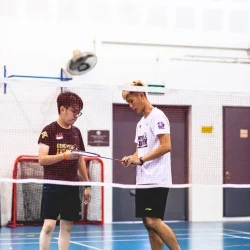
Technical drills matter, but beginners also need exercises that connect strokes to situations. A coach can feed high, flat, and low shuttles while asking the player to choose an appropriate response. Conditioned rallies can reward players for creating space or recovering before attacking.
Sport Singapore supports structured, athlete-focused coaching and learn-to-play programmes. That principle also guides our training, where drills develop movement, timing, consistency, and tactical awareness rather than isolated hitting alone.
Beginners choose the right badminton shot by reading the shuttle height, recognising their court position, checking their balance, observing the opponent, and deciding whether they need time or pressure. Better decisions make basic strokes more effective and reduce avoidable mistakes.
At Dynamic Badminton Academy, our private badminton lessons help children and adults connect technique with real rally situations. We provide personalised feedback and tactical guidance across Singapore. Contact us to begin developing a more controlled and intelligent game.
Beginners should first learn a reliable clear because it develops overhead technique, length control, and recovery time. They should also practise lifts, serves, and simple net returns before depending heavily on smashes or deceptive shots.
No. A high shuttle creates an attacking opportunity, but a smash is suitable only when the player is balanced and ready for the return. A clear or drop may be more effective against an opponent’s position.
Beginners can improve by practising situational drills, observing opponent positioning, and reviewing why rallies were won or lost. Coaching feedback helps them connect shuttle height, balance, court position, and tactical purpose more quickly.
No. A high clear can create recovery time, while an attacking clear can travel flatter and pressure an opponent’s rear court. Its purpose depends on height, speed, placement, and the players’ positions.
Click on the link to find out more about Dynamic Badminton Academy. Chat with our Coach today!
Home
About Us
Private Badminton Lessons
Kids Badminton Lessons
Group Badminton Lessons
WhatsApp Us