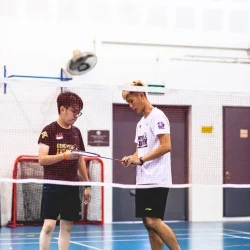


You may keep missing the shuttlecock because your racket preparation is late, your contact point is inconsistent or your body is unbalanced when you swing. Beginners also tend to watch where they want the shot to go instead of tracking the shuttlecock until contact.
At Dynamic Badminton Academy, we often see new players assume that missing is caused entirely by poor hand-eye coordination. Coordination matters, but the problem is usually a combination of timing, grip, spacing and footwork. Once these areas improve, clean contact becomes more reliable.
Late racket preparation is one of the most common reasons beginners miss. When the racket starts moving only after the shuttlecock is already close, the swing becomes rushed and difficult to control.
For overhead shots, turn your body and raise the racket before the shuttlecock reaches the hitting area. For drives and net shots, keep the racket in front so you do not need a large backswing.
Early preparation gives you time to adjust to the shuttlecock’s speed and direction. It also makes the swing smoother and easier to repeat.
Beginners sometimes look towards the opponent’s court before making contact. They may be checking the target, watching the other player or anticipating whether the shot will land in.
Keep your eyes on the shuttlecock until it meets the racket strings. You can choose the target earlier, but your attention should remain on the shuttlecock during the final part of the swing.
This helps you judge distance and timing. It also reduces framing, where the shuttlecock strikes the edge of the racket instead of the string bed.


A late contact point makes the shuttlecock difficult to reach cleanly. Overhead shots are especially challenging when it travels behind your head or drops too low.
Try to contact overhead shots high and slightly in front of your body. Drives should usually be taken in front or beside you rather than after they have passed. Net shots also become easier when you reach forward early.
The correct contact point gives you more space to swing and helps the racket face meet the shuttlecock at a predictable angle.
You cannot hit consistently if your feet do not place your body within a comfortable hitting distance. Beginners often stretch, lean or swing while moving backwards, making clean contact much harder.
Use a split step as your opponent strikes, then move towards the expected landing area. Take small adjustment steps as you approach instead of making one uncontrolled movement. Avoid standing directly underneath the shuttlecock because your racket needs space to travel.
Good footwork helps you arrive balanced and recover after hitting. Structured physical activity and movement development are also encouraged by Sport Singapore.
An unsuitable grip can make the racket face point in the wrong direction. Holding the handle too tightly also limits finger movement and slows down grip changes.
Use a relaxed forehand grip for basic overhead forehand shots and change to a suitable backhand grip when the shuttlecock approaches your backhand side. Avoid using a frying-pan grip for every stroke.
The racket should feel secure without being squeezed constantly. A relaxed grip helps you guide the racket face and make small timing adjustments before contact.
Trying to generate maximum power can cause beginners to swing too early, lose balance or close their eyes during contact. A faster swing also makes small timing errors more difficult to correct.
Practise at a comfortable speed and aim to meet the centre of the string bed. A smooth half-speed stroke is more useful than a powerful swing that rarely contacts the shuttlecock.
Once your timing becomes dependable, increase racket speed gradually. Power should develop from efficient technique rather than excessive tension in the arm and shoulder.
A shuttlecock can slow down quickly and drop steeply. Beginners sometimes move too early or assume it will continue travelling at the same speed.
Watch it from the moment it leaves the opponent’s racket. Pay attention to its height, speed and angle. With experience, you will recognise whether it is travelling deep, falling short or moving towards your body.
Practising with different feeds helps you become familiar with varied trajectories instead of reacting to only one predictable shot.
Start with gentle hand feeds or racket feeds at a consistent height. Focus on preparing early, watching the shuttlecock and making clean contact rather than aiming for a difficult target.
You can also practise self-feeding by dropping the shuttlecock and tapping it upwards. Cooperative rallies at a slow pace help develop rhythm without the pressure of winning.
At Dynamic Badminton Academy, we adjust the feeding speed and direction according to the player’s ability. This allows beginners to succeed before progressing to faster feeds and more challenging movement patterns.
Missing the shuttlecock is normal when you are learning badminton. The solution is not simply to swing more often. You need to prepare early, track the shuttlecock, move into position and contact it at a comfortable height.
At Dynamic Badminton Academy, we help beginners identify why they are missing and correct the problem through progressive drills. Contact us to discuss suitable badminton lessons in Singapore and build more confident, consistent contact.
Yes. Beginners commonly miss because they are still developing timing, visual tracking, grip control and footwork. Regular practice with slower, predictable feeds helps players understand where and when they should contact the shuttlecock.
Keep your eyes on the shuttlecock until it reaches the racket strings. Watching the racket or looking towards the target too early can affect your timing and increase the likelihood of framing or completely missing the shot.
Slow hand-feeding drills are effective because they provide predictable height and speed. Concentrate on preparing the racket early, moving into position and contacting the centre of the string bed before increasing the difficulty.
Some beginners notice better timing within several weeks of regular structured practice. Progress varies according to coordination, training frequency and feedback, but practising correct movements consistently is more effective than repeatedly swinging without technical guidance.
Click on the link to find out more about Dynamic Badminton Academy. Chat with our Coach today!
Home
About Us
Private Badminton Lessons
Kids Badminton Lessons
Group Badminton Lessons
WhatsApp Us