

Beginners can hit the shuttlecock more accurately by improving their grip, footwork, timing, contact point and follow-through. Accuracy does not come from swinging harder. It comes from reaching the shuttlecock in balance and repeating a controlled movement.
At Dynamic Badminton Academy, we teach accuracy before power because beginners progress faster when they can direct the shuttlecock consistently. Once control improves, players can add speed and stronger attacking shots without losing reliability.
A suitable grip allows the racket face to meet the shuttlecock at the intended angle. Beginners often hold the racket like a frying pan or squeeze the handle too tightly, making the racket difficult to control.
We begin with a relaxed forehand grip and introduce the backhand grip when the player is ready. The fingers should guide the racket, while the thumb and index finger provide control during contact.
Players should also practise changing grips between shots. Using one grip for every situation can send the shuttlecock in the wrong direction, especially during backhand returns and net play.
Late preparation forces beginners to rush their swing. This makes the contact point less predictable and often causes mishits.
The racket should be prepared before the shuttlecock arrives. For an overhead shot, the player should turn the body, raise the racket and track the shuttlecock. For net shots and drives, the racket should remain in front.
Early preparation creates more time to adjust and helps players use a controlled swing instead of making a sudden movement at the last moment.


Accuracy becomes difficult when a player reaches, leans or falls while making contact. Good footwork helps beginners arrive early enough to hit from a balanced position.
We teach the split step, directional movement, lunges and recovery. Players should avoid standing flat-footed or running directly underneath the shuttlecock.
The objective is not merely to reach the shuttlecock. The player should arrive with enough space to complete the stroke comfortably and recover for the next return.
The contact point strongly influences direction. Beginners often hit too late, allowing the shuttlecock to travel beside or behind the body.
For overhead strokes, it should usually be contacted high and slightly in front. Net shots and drives are also easier to control when the shuttlecock is met early.
Players can improve by watching the shuttlecock until contact instead of looking towards the target too soon. Keeping the eyes focused on the shuttlecock can also reduce framing and complete misses.
A small change in the racket face can send the shuttlecock away from the intended target. Beginners may twist the wrist excessively or allow the racket angle to change unpredictably.
We encourage players to feel the racket face throughout the stroke. During basic practice, the movement should remain simple and controlled. Excessive wrist action should not compensate for poor positioning.
More advanced actions such as slicing and deception can be introduced after basic control becomes reliable.
Beginners should not begin by aiming for lines or very small targets. Large target zones provide a realistic way to develop control and confidence.
A player may aim for the rear third of the court during clears or the front service area during drop-shot practice. As consistency improves, the target can become smaller.
We often use cones or court sections to create clear objectives. The player should focus on repeated success rather than attempting a perfect shot every time.
Trying to hit too hard is a common reason beginners lose accuracy. A powerful swing can magnify technical errors and make the racket face difficult to control.
Players should begin at a comfortable speed and concentrate on clean contact. The swing can become faster after the movement is consistent.
Controlled practice also teaches beginners how much force each shot requires. Good timing and efficient technique are more dependable than unnecessary muscular tension.
Accuracy improves when beginners receive shuttlecocks at a manageable and predictable pace. Random rallies may be too difficult while the player is still learning how to position the body and racket.
A coach can feed the same shot repeatedly so the player focuses on one technical adjustment. The direction, height and speed can then be changed gradually.
Repetition is effective only when the technique remains correct. Repeating the same mistake does not create reliable improvement and may make the habit harder to correct later.
Beginners sometimes watch their shot and remain in the same position. This makes the next return late and reduces accuracy during rallies.
After hitting, the player should recover towards a suitable base position. Recovery depends on the shot played and the opponent’s likely reply.
Consistent recovery allows earlier preparation for the next stroke. It also supports the active and coordinated movement encouraged by Sport Singapore.
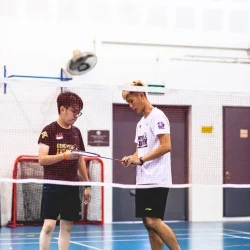
Beginners may not recognise why the shuttlecock keeps travelling too short, too wide or into the net. A coach can identify whether the issue is grip, timing, movement, contact point or racket angle.
At Dynamic Badminton Academy, we provide immediate feedback and adjust each drill according to the player’s needs. Some players require slower feeding, while others need footwork correction or clearer targets.
Video feedback may also help players compare what they feel with what their body is actually doing.
Beginners hit the shuttlecock more accurately when they prepare early, move into balance, contact it in front and control the racket face. Regular target practice and quality feedback make these movements more consistent.
Accuracy should be developed before maximum power. At Dynamic Badminton Academy, we help children and adults build reliable technique through structured badminton lessons in Singapore. Contact us to discuss training suited to your current level.
Beginners should prioritise clean contact and control before trying to hit harder. Once their grip, timing and swing become consistent, power can be increased gradually without causing a major loss of accuracy.
Simple target drills, cooperative rallies and repeated clears or serves are effective. Players should aim for large court areas first, record successful attempts and reduce the target size only after becoming consistent.
Yes. Poor footwork often causes late contact, reaching and loss of balance. When players move efficiently and arrive earlier, they can prepare the racket properly and direct the shuttlecock with much greater control.
Some beginners improve their basic control within several weeks of regular practice. The rate of progress depends on training frequency, coordination, coaching feedback and whether technical mistakes are corrected before they become established habits.
Click on the link to find out more about Dynamic Badminton Academy. Chat with our Coach today!
Home
About Us
Private Badminton Lessons
Kids Badminton Lessons
Group Badminton Lessons
WhatsApp Us