

Beginners can improve their badminton skills by developing the correct grip, learning basic footwork, practising essential strokes and building consistency through structured training. Progress comes faster when players focus on strong foundations instead of advanced techniques too soon.
At Dynamic Badminton Academy, we help beginners understand how movement, positioning and stroke technique connect. With patient coaching and regular practice, players can improve steadily with confidence.
The grip affects power, accuracy, control and the ability to switch between forehand and backhand shots. Many beginners hold the racket too tightly or use one grip for every stroke, which restricts wrist movement.
We teach players to begin with a relaxed forehand grip before learning the backhand grip and simple grip changes. The fingers should guide the racket instead of squeezing the handle constantly. Practising these changes without a shuttlecock can help the movement feel natural.
Good footwork helps players reach the shuttlecock early and remain balanced when hitting. Beginners often run directly towards the shuttlecock or forget to recover after a shot.
We introduce the split step, directional movement, lunges and recovery to the base position. Shadow footwork is useful because players can focus entirely on movement without worrying about the shuttlecock.
The goal is to move smoothly and stay balanced. Speed should only be added after the movement pattern becomes reliable.


Beginners should first learn the serve, clear, lift, drop shot, net shot and basic drive. These strokes provide enough variety to start rallies and understand different areas of the court.
Each stroke should be broken into preparation, contact point and follow-through. We encourage beginners to practise one skill at a time before combining several shots.
Repetition matters, but quality is more important than volume. Coaching feedback helps players correct mistakes before inefficient habits become difficult to change.
Early contact gives players more options and reduces the pressure created by late movement. Beginners commonly allow the shuttlecock to fall too low or travel behind the body.
For overhead strokes, players should contact it high and slightly in front. At the net, reaching forward early can create better control.
Players should not rush. They must first move into position, prepare the racket and maintain balance. Earlier contact then makes it easier to direct the shuttlecock accurately.
Many beginners want to develop a powerful smash immediately. However, power is less useful when the shuttlecock regularly lands outside the court or the player loses balance.
We prioritise clean contact, sound technique and accurate placement. Simple targets can help players practise hitting towards the back court, sidelines or front corners.
As technique improves, racket speed and power can be developed gradually. Building power on top of good mechanics produces more consistent results.
Consistency means returning the shuttlecock repeatedly without unnecessary errors. Beginners can improve through cooperative rallies, controlled feeding and clear targets.
Instead of trying to win every exchange, players can count how many consecutive shots they complete. We may begin with half-court rallies before progressing to the full court.
This develops patience, concentration and racket control. As confidence grows, rallies can become faster and include more varied strokes.
Badminton requires balance, agility, coordination, leg strength and stamina. Beginners do not need an advanced fitness programme, but basic physical preparation makes learning easier.
Skipping, agility drills, bodyweight exercises and short movement circuits can support court performance. Mobility work for the ankles, hips and shoulders can also help.
Training should suit the player’s age and ability. Gradual progression supports the active lifestyle promoted by Sport Singapore while reducing excessive fatigue and avoidable strain.
Beginners often watch their own shot and remain in the same place. This leaves open spaces and makes the next return more difficult.
After hitting, the player should recover to a position that allows movement towards likely replies. In singles, this is usually near a suitable central base. In doubles, positioning changes according to whether the pair is attacking or defending.
Better court awareness helps beginners conserve energy, react earlier and support tactical development.
Improvement depends on regular practice rather than occasional long sessions. One or two focused sessions each week can be more productive than irregular practice without a plan.
Beginners should concentrate on a small number of skills during each session. One session may focus on serving and grip, while another develops footwork and clears.
We encourage players to track specific progress, such as completing longer rallies, reaching the shuttlecock earlier or serving more accurately. Small improvements are easier to recognise when training has a clear purpose.
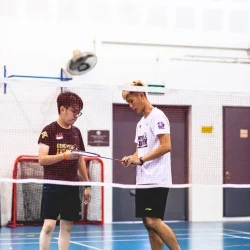
A coach can identify errors that beginners may not notice themselves. Immediate feedback helps players understand what to change and how the correction should feel.
At Dynamic Badminton Academy, we adjust training according to each player’s age, experience and goals. Some beginners require more coordination work, while others are ready to progress into movement and rally drills.
Structured coaching provides a clear learning sequence and prevents players from repeatedly practising the wrong technique.
Beginners improve their badminton skills by developing the correct grip, efficient footwork, essential strokes, early contact, accuracy and consistency. Fitness, court positioning and regular practice support these technical foundations.
Progress should be measured over time rather than after one session. At Dynamic Badminton Academy, we help children and adults build their skills step by step. Contact us to discuss suitable badminton lessons in Singapore.
Most beginners benefit from one or two structured sessions each week. Regular practice is more important than training for many hours occasionally. Additional light footwork or serving practice can support improvement between coached sessions.
Beginners usually notice better control and confidence within several weeks of consistent practice. However, progress depends on training frequency, coordination, previous sporting experience and whether the player receives feedback that corrects technical mistakes early.
Private coaching is not compulsory, but it can accelerate improvement by providing individual feedback and a structured learning sequence. Group lessons can also be effective when the coaching level, class size and training pace are appropriate.
Beginners should choose a lightweight racket that feels comfortable and is easy to control. An expensive professional racket is unnecessary at the start because suitable technique, timing and regular practice influence improvement more than equipment price.
Private lessons typically start from around $90 per hour, depending on the package and session duration.
Click on the link to find out more about Dynamic Badminton Academy. Chat with our Coach today!
Home
About Us
Private Badminton Lessons
Kids Badminton Lessons
Group Badminton Lessons
WhatsApp Us