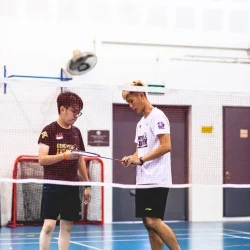

Footwork Mastery: Lessons from Kunlavut Vitidsarn’s Singapore Open Victory

Footwork Mastery Lessons from Kunlavut Vitidsarn’s Singapore Open Victory

Share This Post

Footwork Mastery: Lessons from Kunlavut Vitidsarn’s Singapore Open Victory

For those who watched Kunlavut Vitidsarn glide across the court during the Singapore Open 2025, one thing was clear—his footwork wasn’t just fast; it was poetic. Like a seasoned chess master, he anticipated every move, repositioned with grace, and never once seemed out of place. Behind every smash, drop shot, and rally-saving dive (okay, maybe not “dive”) was a foundation of elite-level footwork. And if there’s one lesson local players can walk away with, it’s this: if your feet can’t keep up, your racket won’t stand a chance.

At Dynamic Badminton Academy, we’ve always believed that strong footwork is the bedrock of a great game. Watching Kunlavut play was a timely reminder of that truth—and a powerful teaching opportunity for every player aspiring to improve.

Why Footwork Matters in Every Rally

Let’s face it: badminton isn’t just about hitting hard. It’s about reaching the shuttle early enough to make smart choices. Kunlavut’s performance showcased how great footwork doesn’t just improve your speed—it actually slows down the game for you. That’s right. With proper positioning, even the most aggressive smashes and deceptive drop shots lose their sting.

Footwork allows players to conserve energy, create better shot angles, and avoid panic-mode swings. For many beginners or even intermediate players in Singapore, it’s tempting to focus on racket skills alone. But the truth is, a powerful smash won’t help if you can’t get behind the shuttle in time to deliver it.

What Kunlavut Did Differently

While most players were still planting their feet, Kunlavut had already taken his split step. His footwork was so light and precise that it seemed like he was dancing on air. Each movement was measured—not too long to lose balance, not too short to delay the next step.

Footwork Mastery Lessons from Kunlavut Vitidsarn’s Singapore Open Victory

At Dynamic Badminton Academy, we often remind students that footwork is a blend of anticipation, strength, and rhythm. Kunlavut’s Singapore Open matches were a highlight reel of these three elements in action.

What stood out even more was how effortlessly he transitioned between defensive and offensive positions. Whether retrieving a tight net shot or lunging into a cross-court smash, his movement never looked strained. That’s not magic—it’s mastery.

The Split Step: The Unsung Hero

The split step is one of those deceptively simple moves that separate the weekend warriors from the serious contenders. You might’ve noticed Kunlavut taking a small hop before reacting to his opponent’s shot. That’s the split step. It resets your balance, readies your muscles, and primes your body for an explosive push-off in any direction.

It’s not flashy, and you probably won’t get any applause for it, but without it, you’re basically reacting half a beat too late. We see this often during badminton trial class sessions—students who skip the split step often find themselves a step behind the rally, quite literally.

Footwork Isn’t One-Size-Fits-All

Here’s the tricky part: copying Kunlavut’s footwork exactly might not work for every player. He has a specific body type, muscle composition, and playing style. But what Singaporean players can do is study his principles and adapt them.

Shorter steps when moving forward. A wider base when defending smashes. Proper recovery steps after lunges. Each of these principles can be tailored for different age groups, fitness levels, and match styles. Whether you’re a 12-year-old beginner or a weekend warrior in your 40s, your footwork can—and should—be trained.

Local Insights: The Singaporean Edge

In Singapore, where court time is often limited and players juggle sports with school or work, efficiency becomes even more crucial. According to a 2024 case study published by Sport Singapore, footwork efficiency directly correlated with match win rates among youth players aged 11 to 17. Players who regularly trained agility drills and split-step timing were 28% more likely to win their school league matches (source).

Another study conducted by ActiveSG in early 2025 focused on injury prevention and revealed that poor footwork habits—particularly awkward lunges and overextension—were a leading cause of knee injuries in school players. The takeaway? Mastering footwork doesn’t just help you win. It helps you play longer.

Drills That Reinforce Good Footwork

At Dynamic Badminton Academy, we implement drills that reflect real-game scenarios. Multi-shuttle drills are especially popular, forcing players to move from backcourt to net and side-to-side in rapid succession. Think of it like controlled chaos—it challenges players to maintain proper form under fatigue.

Shadow drills are another crowd favourite. No shuttle, no opponent, just pure movement. It’s one of those “looks easy, feels painful” exercises that build muscle memory and rhythm. And let’s not forget ladder footwork training—excellent for improving explosive steps and coordination.

The Mental Side of Footwork

Footwork isn’t all in the legs—it starts in the mind. Anticipation is just as vital as agility. What made Kunlavut’s footwork so effective wasn’t just his speed; it was his ability to read the game.

For young athletes or adult learners here in Singapore, this means watching more games, understanding shot patterns, and becoming students of the sport. Learn to see the shuttle’s flight early, and you’ll move smarter, not harder.

We often encourage our players during lessons to mentally map out their movement options after every shot. It might sound like overthinking, but it becomes second nature with practice. That’s when the real magic happens—when your body reacts before your mind even finishes processing.

Avoiding Common Footwork Pitfalls

It’s not all smooth sailing. Many players fall into habits that undo all their good work. Crossing your feet during lateral movements, overcommitting to one direction, or simply standing flat-footed after a shot—these are all common missteps we address early in training.

Often, the problem lies in neglecting recovery. You can play a brilliant net shot, but if you don’t return to the centre with control, your next move could turn into a scramble. Kunlavut’s game demonstrated near-perfect recovery after every shot, and that’s something we strive to instil in our students from day one.

Building a Long-Term Foundation

What Kunlavut showed at the Singapore Open wasn’t a product of overnight magic—it was years of training, drilling, correcting, and repeating. For local players aiming to reach national-level competitions or just looking to dominate in weekend games, the blueprint is there.

We’ve seen students who came in struggling to cover half the court, and within months of consistent footwork training, they were playing rallies they couldn’t have imagined. It’s a transformation that doesn’t just improve your game—it boosts confidence too.

Beyond the Court: Discipline and Control

Interestingly, footwork training spills over into other areas of life. Discipline, focus, resilience—these traits get reinforced every time you commit to mastering your steps. One of our long-time students, Marcus, a JC student from Queenstown, once shared how the discipline of footwork drills helped him manage exam stress. “If I can keep up with 5-point movement drills, a maths paper can’t break me,” he joked. That’s the kind of mental strength badminton builds, one step at a time.

Where to Begin

For anyone inspired by Kunlavut’s display, the first step is literally that—a step. Whether you’re exploring the game through a badminton trial class or deep into private training, prioritising footwork can be the game-changer.

Our coaching team customises lessons to match each player’s needs, with a strong emphasis on balance, technique, and repeatable movement. It’s not about mimicking champions move for move—it’s about finding your own rhythm, and making your footwork work for you.

Final Thoughts: Move With Intention, Play With Confidence

Footwork might not be the flashiest skill, but it’s the foundation every great game rests upon. As Kunlavut Vitidsarn proved at the Singapore Open, movement with intention can break opponents and build victories.

If you’re ready to transform how you move on court and take your game to the next level, visit Dynamic Badminton Academy today. Whether you’re looking to book your first badminton lesson or want to fine-tune your competitive edge, we’re here to get you where you need to be—one step at a time.

Click on the link to find out more about Dynamic Badminton Academy. Chat with our Coach today!
About Us
Private Badminton Lessons
Kids Badminton Lessons
Group Badminton Lessons
WhatsApp Us

Leave a Reply

Your email address will not be published. Required fields are marked *

More To Explore

Why Is Consistency Important In Badminton
Badminton Guide

Why Is Consistency Important In Badminton

Why Is Consistency Important In Badminton If you have ever played a badminton match where you hit a brilliant shot one moment and a simple error the next, you already understand the importance of consistency. Badminton is not won by occasional flashes of brilliance. It is won by players who can perform reliably, point after point, under pressure. Understanding why consistency is important in badminton is the key to unlocking steady improvement. Whether you are a beginner learning the basics or an intermediate player trying to level up, consistency is what transforms potential into performance. Consistency Builds Reliable Shot Control In badminton, control is everything. It does not matter how powerful your smash is if you cannot place it accurately. Consistency ensures that your shots land where you intend them to, not just once, but repeatedly. When players train consistently, their strokes become more stable. The racket angle, timing, and contact point become predictable. This reduces unforced errors and increases confidence during rallies. Instead of worrying about whether a shot will go out, players can focus on strategy and positioning. Consistency in technique often begins with mastering the basics. Small details like grip and wrist control play a major role. Our guide on badminton grip techniques explains how proper fundamentals lead to better shot reliability over time. Consistency Reduces Unforced Errors One of the most common reasons players lose points is not because of their opponent’s skill, but because of their own mistakes. These are known as unforced errors. Missing easy shots, hitting the shuttle out, or mistiming simple returns can quickly cost you a game. Consistency helps eliminate these errors. When your movements and strokes are repeatable, your margin for error decreases. You become more dependable on court, which puts pressure on your opponent to take risks instead. Research from the Journal of Sports Sciences highlights that players with higher shot consistency win a greater percentage of rallies, even against technically stronger opponents. This shows that consistency is often more important than raw skill. Consistency Improves Footwork And Positioning Consistency is not just about hitting the shuttle. It also applies to movement. Players who move inconsistently often arrive late, lose balance, and struggle to execute shots properly. Consistent footwork ensures that you reach the shuttle in the right position every time. This allows you to maintain control and recover quickly for the next shot. Over time, consistent movement reduces fatigue because you are no longer wasting energy on inefficient steps. If you want to improve your movement patterns, our article on badminton footwork training explains how structured drills build reliable and efficient court coverage. Consistency Builds Confidence On Court Confidence and consistency go hand in hand. When players know they can execute shots reliably, they play with greater confidence. They commit to their decisions and stay calm during rallies. On the other hand, inconsistent players often hesitate. They second-guess their shots, which leads to more mistakes. This creates a negative cycle where lack of confidence leads to poor performance, and poor performance further reduces confidence. Consistency breaks this cycle. Each successful shot reinforces belief in your abilities. Over time, this builds mental strength and resilience, allowing you to perform better under pressure. Consistency Helps You Control The Game Badminton is not just about reacting. It is about controlling the pace and flow of the game. Consistent players can maintain rallies, dictate tempo, and force opponents into difficult positions. By keeping the shuttle in play and applying steady pressure, you increase the chances of your opponent making a mistake. This is especially important in competitive matches where patience and discipline often determine the outcome. Consistency allows you to execute game plans effectively. Whether you are playing defensively or attacking aggressively, reliability in your shots ensures that your strategy works as intended. Consistency Comes From Structured Training Consistency is not something that happens by accident. It is built through repetition, discipline, and structured training. Random play may be enjoyable, but it does not always lead to improvement. The most effective way to build consistency is through focused drills that target specific skills. Repetition helps develop muscle memory, making movements automatic. Over time, this leads to more stable performance. According to Sports Singapore, structured training programs are essential for developing consistent performance in sports. Their initiatives emphasize the importance of regular practice and guided coaching in building long-term athletic success. You can learn more at http://sportsingapore.gov.sg/. A 2023 study in the International Journal of Sports Science also found that athletes who followed structured training routines showed greater consistency in performance compared to those who trained irregularly. This highlights the importance of discipline and routine. Consistency Separates Good Players From Great Players At higher levels of badminton, the difference between players becomes smaller. Many players have strong techniques and physical abilities. What sets great players apart is their ability to perform consistently under pressure. Advanced players rarely make simple mistakes. They maintain focus, execute shots reliably, and adapt to different situations without losing control. This level of consistency is what allows them to win matches regularly. For players aiming to improve, focusing on consistency is one of the most effective ways to progress. It creates a strong foundation that supports all other aspects of the game. Why Coaching Accelerates Consistency Building consistency on your own can be challenging. Without feedback, it is difficult to identify mistakes or refine techniques. This is where coaching plays a crucial role. A coach provides guidance, corrects errors, and designs training sessions that target specific areas for improvement. This structured approach helps players develop consistent habits more quickly. At Dynamic Badminton Academy, training programs focus on building consistency through targeted drills, personalized coaching, and progressive learning. Players are guided step by step, ensuring steady and sustainable improvement. Conclusion Understanding why consistency is important in badminton can transform the way you train and play. Consistency improves shot control, reduces errors, enhances movement, builds confidence, and allows you to control the game. It is the foundation of reliable performance

What Is The Best Way To Train For Badminton
Badminton Guide

Best Way To Train For Badminton Effectively

What Is The Best Way To Train For Badminton If you have ever stepped onto a badminton court and felt like your effort did not match your results, you are not alone. Many players train regularly but still struggle to improve. The real question is not how often you train, but how you train. Understanding the best way to train for badminton can make the difference between slow progress and noticeable improvement. Badminton is a sport that demands speed, precision, endurance, and mental sharpness. Training must reflect all these elements. It is not about hitting hundreds of shots randomly. It is about structured, purposeful training that builds skills step by step. Start With Strong Fundamentals The best way to train for badminton always begins with fundamentals. Even advanced players revisit basic techniques regularly. Grip, footwork, and stroke mechanics form the foundation of every shot you play. Without proper grip, your control suffers. Without proper footwork, you arrive late to the shuttle. Without correct technique, you waste energy and lose consistency. Training these fundamentals repeatedly ensures your movements become efficient and reliable. If you want to refine your control and shot execution, our guide on badminton grip techniques explains how small adjustments can improve overall performance significantly. Train Footwork For Speed And Efficiency Footwork is often underestimated, yet it is one of the most important aspects of badminton training. The best way to train for badminton includes developing quick, efficient movement across the court. Good footwork allows you to reach the shuttle early, maintain balance, and execute shots with confidence. Poor movement leads to rushed shots and unnecessary errors. Training should focus on explosive starts, quick recovery, and smooth directional changes. Advanced players spend a significant amount of time on movement drills because they understand that better positioning leads to better shot quality. To improve your court coverage, you can explore our article on badminton footwork training. Incorporate Structured Drills Instead Of Random Play Many players rely on casual games as their main form of training. While games are enjoyable, they do not always target specific weaknesses. The best way to train for badminton is through structured drills designed to improve particular skills. Drills focus on repetition, consistency, and precision. Whether it is practicing net shots, defensive lifts, or smash recovery, structured drills help build muscle memory. Over time, these movements become automatic, allowing players to focus on strategy rather than execution. Training sessions should include both isolated drills and game-like scenarios to ensure skills transfer effectively into real matches. Build Strength And Conditioning Badminton is physically demanding, requiring a combination of speed, endurance, and strength. Training should include conditioning exercises that support these demands. Agility drills improve reaction time and movement speed. Strength training enhances power and stability. Endurance training ensures you can maintain performance throughout long rallies and matches. According to Sports Singapore, incorporating physical conditioning into sports training significantly improves performance and reduces injury risk. Their programs emphasize the importance of combining technical skills with physical fitness for long-term development. You can find more information at http://sportsingapore.gov.sg/. A 2023 study in the Journal of Strength and Conditioning Research also found that athletes who included sport-specific conditioning experienced improved speed, recovery, and overall performance. This highlights the importance of a balanced training approach. Focus On Match Play And Tactical Awareness Training is not complete without applying skills in match situations. The best way to train for badminton includes understanding strategy and decision-making. Players must learn when to attack, when to defend, and how to control the pace of a rally. Tactical awareness allows you to exploit opponents’ weaknesses and adapt your game accordingly. Match play also helps build confidence. It teaches players how to handle pressure, manage mistakes, and stay focused during competition. Combining drills with match scenarios ensures a well-rounded training experience. Train Consistently With Clear Goals Consistency is one of the most important factors in badminton training. Training once in a while may feel productive, but it does not build lasting improvement. The best way to train for badminton is through regular, structured sessions with clear objectives. Setting specific goals for each session keeps training focused. Instead of practicing everything at once, players can target one or two areas for improvement. Over time, these small gains accumulate into significant progress. Consistency also builds confidence. When players know they have trained regularly, they trust their abilities more during matches. Learn From Professional Coaching Self-training has its limits. Without proper guidance, players may develop bad habits or overlook areas that need improvement. The best way to train for badminton includes learning from experienced coaches. A coach provides feedback, corrects technique, and designs training programs tailored to your level. This ensures efficient progress and reduces the risk of injury. Coaching also introduces structure and accountability, which are essential for long-term development. At Dynamic Badminton Academy, training programs combine technical drills, physical conditioning, and tactical development to help players improve effectively and confidently. Conclusion The best way to train for badminton is not about doing more, but doing the right things consistently. Strong fundamentals, efficient footwork, structured drills, physical conditioning, tactical awareness, and professional coaching all play a role in improving performance. When training is purposeful and consistent, progress becomes clear and rewarding. If you are ready to train smarter and elevate your game, visit Dynamic Badminton Academy and experience structured badminton training designed for real improvement. FAQ Q: What is the best way to improve badminton skills quickly? A: Structured training with drills, coaching, and consistent practice is the fastest way to improve. Q: How often should I train for badminton? A: Training two to three times a week with focused sessions is effective for steady improvement. Q: Is playing games enough to improve in badminton? A: No. Games help apply skills, but drills are necessary to build technique and consistency. Q: Do I need fitness training for badminton? A: Yes. Strength, agility, and endurance training improve performance and reduce injury risk. Click on the link to find out

How To Become Advanced In Badminton
Badminton Guide

How To Become Advanced In Badminton

How To Become Advanced In Badminton Every badminton player reaches a stage where improvement starts to slow down. You can rally well, execute basic shots, and enjoy the game, but breaking into the advanced level feels just out of reach. If you have ever asked yourself how to become advanced in badminton, the answer lies in refining details, building consistency, and training with purpose. Becoming an advanced player is not about one breakthrough moment. It is about stacking small improvements consistently until your game transforms. The difference between intermediate and advanced players is often not talent, but discipline, structure, and awareness. Master The Fundamentals At A Higher Level It may sound ironic, but advanced badminton begins with mastering the basics again. The difference is in the level of precision. Advanced players do not just perform strokes, they execute them with control, timing, and consistency. Grip technique, for example, is no longer just about holding the racket correctly. It becomes about subtle adjustments that allow faster transitions between shots. Footwork is no longer about reaching the shuttle, but arriving early and balanced. These small refinements create a huge performance gap. If you want to strengthen your technical base, understanding badminton grip techniques is a key starting point. Advanced players rely heavily on efficient grip changes to control pace and direction. Develop Advanced Footwork And Court Awareness Movement is what separates good players from advanced ones. Advanced players do not chase the shuttle, they anticipate it. Their footwork is efficient, controlled, and explosive when needed. To become advanced in badminton, you must train your ability to move quickly while staying balanced. This includes mastering recovery steps, split-step timing, and directional changes. Better footwork gives you more time to think, which improves shot selection and reduces panic. Court awareness also improves at this level. Players learn to read opponents, predict shot patterns, and position themselves proactively. Our article on badminton footwork training explains how movement efficiency directly impacts performance and confidence. Train With Consistency And Structure One of the biggest differences between intermediate and advanced players is consistency in training. Casual play is no longer enough. You need structured sessions that focus on specific skills, repetition, and progression. Training should include a mix of technical drills, match simulations, and physical conditioning. Each session should have a purpose, whether it is improving net control, defensive skills, or attacking precision. According to Sports Singapore, structured training programs play a crucial role in developing athletic performance and long-term improvement. Their initiatives highlight how consistent and guided practice leads to better results and sustained motivation. You can learn more at http://sportsingapore.gov.sg/. Consistency builds muscle memory, and muscle memory builds confidence. When movements become automatic, your focus shifts from execution to strategy. Improve Shot Quality And Variation Advanced players are not predictable. They do not rely on one or two shots. Instead, they use a variety of strokes to control the pace and direction of the game. To become advanced in badminton, you must develop the ability to change speed, disguise shots, and place the shuttle precisely. This includes mastering drops, drives, smashes, clears, and net play under different conditions. Shot quality also matters more than power. A well-placed shot often wins more points than a powerful one. Advanced training focuses on accuracy, timing, and decision-making rather than just strength. Build Physical Conditioning For High Performance Badminton at an advanced level is physically demanding. Players need speed, endurance, agility, and strength to sustain high-intensity rallies. Conditioning becomes a key part of training. This includes interval training, agility drills, and strength exercises that support movement and stability. A strong core improves balance, while leg strength supports explosive movement and recovery. A 2023 study published in the Journal of Sports Sciences found that athletes who incorporated sport-specific conditioning improved both performance and recovery rates. This shows that physical training is essential for reaching advanced levels in badminton. Strengthen Your Mental Game Mental strength is often the defining factor at higher levels. Advanced players stay calm under pressure, make quick decisions, and recover quickly from mistakes. They trust their training and stay focused on the next point. Learning how to manage emotions, stay composed, and maintain concentration is critical. Confidence grows when you know you are prepared. This is why advanced training includes match scenarios that challenge both physical and mental endurance. Mistakes become part of the process rather than something to fear. Advanced players focus on learning from errors instead of dwelling on them. Learn From Coaching And Feedback No player becomes advanced alone. Coaching provides direction, correction, and progression. A good coach identifies weaknesses, refines technique, and pushes players beyond their comfort zone. Feedback is essential for improvement. Without it, players may continue repeating the same mistakes without realizing it. Coaching accelerates progress by ensuring every training session contributes to development. At Dynamic Badminton Academy, training programs are designed to help players transition from intermediate to advanced levels through structured coaching, targeted drills, and personalized guidance. Conclusion Understanding how to become advanced in badminton is about more than just playing more games. It requires mastering fundamentals at a higher level, improving footwork, training consistently, refining shot variation, building physical conditioning, and strengthening mental resilience. With the right approach and guidance, progression becomes clear and achievable. If you are ready to take your badminton skills to the next level, visit Dynamic Badminton Academy and train with experienced coaches who can guide your journey towards advanced performance. FAQ Q: How long does it take to become advanced in badminton? A: It depends on training consistency, but most players see significant progress within months of structured practice. Q: What is the most important skill for advanced badminton? A: Footwork is critical, as it affects positioning, balance, and overall shot quality. Q: Do I need a coach to become advanced in badminton? A: Yes. Coaching provides structured training and feedback that accelerates improvement. Q: Can adults become advanced in badminton? A: Absolutely. With consistent training and proper guidance, adults can reach advanced