Badminton Serve: Types, Technique And Rules For Beginners
Badminton Serve Guide For Beginners
Every rally starts with a badminton serve, so a reliable serve gives you a calm start to each point. This guide explains the four main serves, when to use a forehand or a backhand, the service rules you must follow, and how our coaches in Singapore help you build a serve you can trust.
A badminton serve is hit underarm from your service court, diagonally over the net into your opponent’s service court. The main types are the low serve, the high serve, the flick serve and the drive serve. The whole shuttle must be below 1.15 metres when you hit it, your racket must strike the base of the shuttle first, and both feet stay on the floor.
Badminton Serve Basics
You start each badminton serve from your service court, standing inside it and keeping clear of its lines, while your opponent stands in the service court diagonally opposite. Hold the shuttle by its feathers, drop it in front of you, and swing the racket forwards to meet the base of the shuttle.
A good badminton serve is consistent before it is clever. Aim first to land the shuttle in the right service court every time, then learn to vary its height and length.
The Low Serve
The low serve, also called the short serve, travels just over the net and drops near the front of your opponent’s service court. It is the standard serve in doubles, because it gives the receiver little chance to attack.
For this badminton serve, use a short, controlled push rather than a full swing. Your aim is a flat path that clears the tape by a small margin, so the shuttle starts falling as soon as it crosses the net.
The High Serve
The high serve sends the shuttle high and deep, so it drops steeply near the back of your opponent’s service court. It is the classic serve in singles, because it pushes your opponent to the back and gives you time to settle in the middle of the court.
Use a full forehand swing and lift the shuttle well above head height. A high serve that falls short invites a smash, so length matters more than power.
Flick And Drive Serves
The flick serve looks like a low serve until the last moment, when a quick snap of the wrist lifts the shuttle over the receiver’s head. It works best against a receiver who rushes forward to attack your low serve.
The drive serve travels fast and flat towards the receiver’s body or the back of the service court. Both are surprise serves, so each badminton serve of this kind works best when you mix them in with your usual low or high serve.
Forehand Or Backhand Badminton Serve
A forehand badminton serve swings from your racket side and suits high serves, which need a long swing. A backhand serve is played in front of your body with a short push, which makes it popular for low serves in doubles.
Many beginners start with the forehand serve, then learn the backhand serve once their low serve needs more control. Our guide on how beginners improve badminton skills explains how to build each stroke step by step.
Badminton Serve Rules To Know
The BWF Laws of Badminton set out what makes a correct serve. Some part of both of your feet stays in contact with the court and stationary from the start of the serve until the shuttle is hit. The whole shuttle must be below 1.15 metres at the moment of contact, and your racket must first hit its base.
Your racket keeps moving forwards once the serve starts, and the shuttle must travel upwards over the net towards the receiver’s service court. Our guide to badminton scoring explains which service court you serve from as the score changes.
Choosing A Serve In Singles And Doubles
In singles, the long, narrow service court rewards a deep high serve, with the low serve as a change of pace. In doubles, the service court is wider but shorter, so the low serve is the main choice and the flick serve keeps receivers honest.
Our guide to badminton court size shows the service lines that make each game’s serving area different.
Common Serving Mistakes
Beginners often hit the shuttle too high on a low serve, which gives the receiver an easy attack. Others lift a foot or step forward during the serve, or pause after the backswing, which the laws count as an undue delay.
Keep your badminton serve routine simple and the same every time: set your feet, check the receiver is ready, and make one smooth forward swing.
Practising Your Serve In Lessons
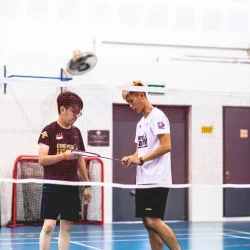
Our coaches call out the score during games and explain the rules as you play, so serving from the right court soon becomes natural. In our private badminton lessons, the coach can watch every serve and correct your swing straight away.
Our kids badminton lessons and group badminton lessons run on public courts, such as ActiveSG sport halls and community club halls. Lessons start from as early as 8am every day, with 2 hours as the standard session.
Enquiring About Badminton Lessons
WhatsApp us with your age or your child’s age, playing level, preferred time and preferred location. We will reply with a class you can join or a court we can book for your lessons.
It is a fault. Under the BWF laws, a serve counts as delivered once you swing at the shuttle, so missing it completely ends the rally and the point goes to your opponent.
Where can my doubles partner stand when I serve?
Your partner can take up any position within your side of the court, as long as they leave the opposing server and receiver with a clear view of the shuttle throughout the serve.
What happens if the serve is caught in the net?
It is a fault. A serve that stays balanced on top of the net, or that crosses the net and then gets caught in it, ends the rally in your opponent’s favour.
Who serves first in the next game?
The side that won the previous game serves first in the next one, starting from the right service court because its score in the new game is zero, an even number.